

Nafisa
Nafisa (نفیسه) means precious and is a popular name among Iranians/Persians. During the 1980s, I knew a girl in Iran named Nafisa who lived in my childhood neighbourhood in the north of Tehran. I did not expect to see the same name next to a series of outstanding artworks in a gallery in Bowral, Australia, 40 years later.
Last Saturday, we decided to go on a short trip to Bowral, a long overdue plan to visit the beautiful Southern Highlands of NSW that is only a 2-hour drive from Canberra.
The most fascinating moments in my life have happened just like this one out of the blue. There was a time when I had to handle some administrative work related to our immigration procedure at the Ministry of Foreign Affairs in the heart of Tehran. Spurred by my usual curiosity, I found my way to the nearby Malek Museum. This incident led to my acquaintance with Malek’s daughter, which resulted in many other memorable adventures, including an invitation to one of their incredible 300-year-old residences from the Safavid dynasty in Isfahan.
White Cottage Gallery in Bowral
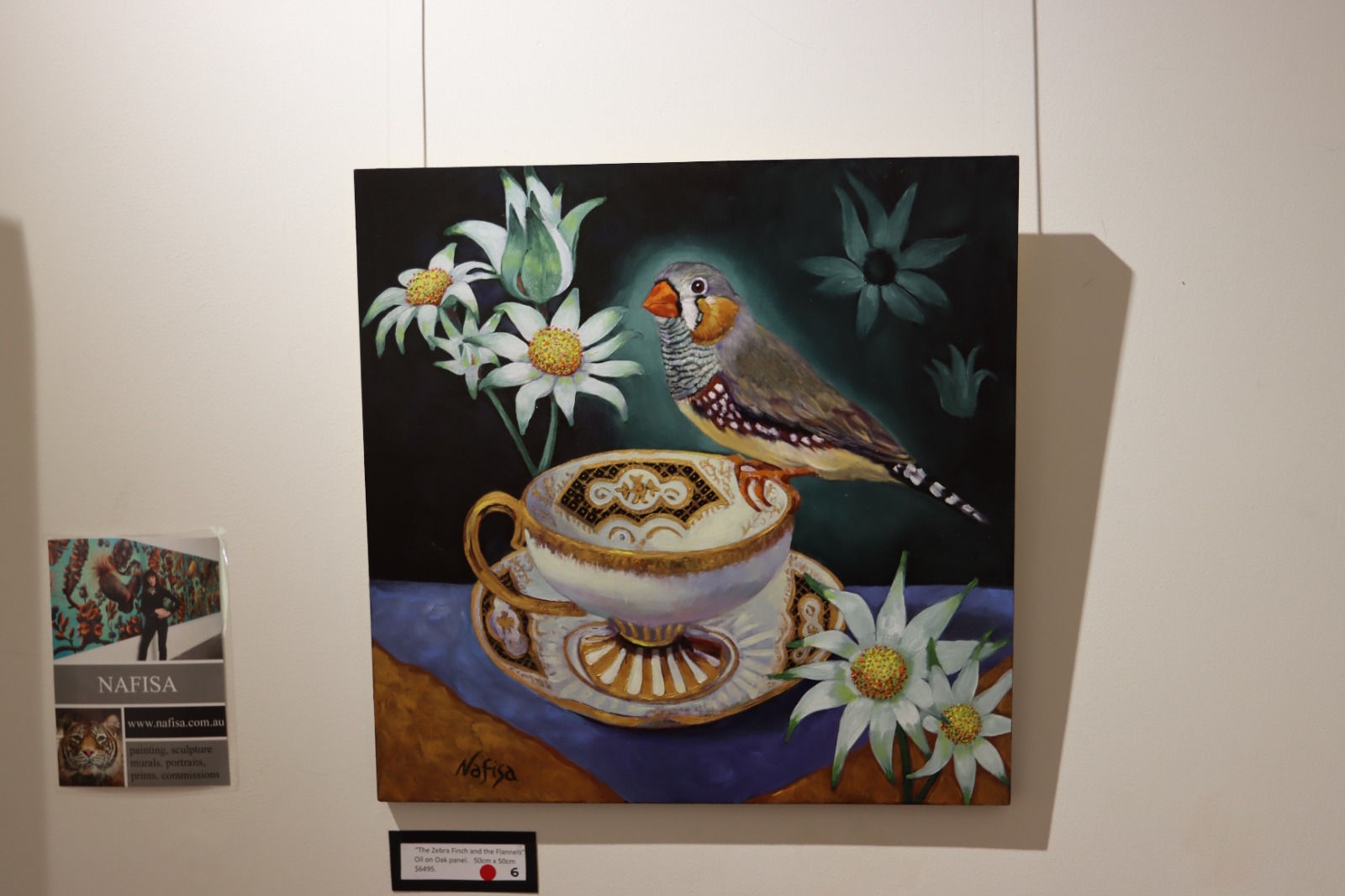
I was captivated by the fascinating artworks of a seemingly renowned Australian artist while waiting for my daughter in the hall of the White Cottage Gallery in Bowral. Following along with the string of artworks displayed on the walls throughout a slim hallway and into the main exhibition rooms, I saw her name, Nafisa, and her memorable face on the brochures. Although I knew she was not the same Nafisa from my childhood, something about her appeared to be quite familiar. With my usual unleashed curiosity, I left my daughter and went to the room where I heard the artist was present. She was standing there in her beautiful burgundy dress and stylishly cut coloured blond hair, the leash of her petite and charming poodle in hand, talking to two men.
I approached her and inquired if she was from Iran/Persia. Her facial expression changed from excitement to disappointment for just a brief moment before she promptly replied, “No”. I am certain that the disappointment shifted from her face to mine. As I tried to conceal it, I inquired, “But Nafisa is an Iranian/Persian name.” She quickly agreed with me and explained that her father is from the Parsi Zoroastrian community of India and that she was born there to a Dutch mother.
Roots
After the Islamic invasion of Iran/Persia over 1400 years ago, there were multiple major waves of immigration. The first wave occurred immediately after the defeat of the Sassanid Empire when a group settled in Gujarat, India and called themselves Parsi. They were permitted to stay in India under the conditions that they wore local clothing and didn’t promote their religion. The second wave followed after the Safavid Empire united Iran/Persia again, and many Zoroastrians were forced to change their religion or were killed. Those who survived escaped to India and called themselves Irani (learn more about Zoroastrianism) .
These waves of immigration slowed down and perhaps even changed in reverse during the reign of the Pahlavi dynasty, which saw the restoration of Zoroastrians as true Iranians. Unfortunately, this was so short-lived, and after the Islamic Revolution in 1979, other waves of immigration from Iran ensued each time people tried to pursue change and, in turn, were suppressed by the Islamic regime and laws. This time, not only Zoroastrians but even born Muslims whose ancestors forcefully accepted Islam and now wanted to return to their roots left Iran. My family and I left Iran after the Green Movement. The Green Movement was a peaceful campaign that hoped to make changes from within the system without violence but was not only repressed by the radicals’ brutality but also manipulated by mullahs who called themselves reformists but were no different from the radicals.


Nafisa Naomi – Fur, Feathers, Flowers, Florence
Although Nafisa Naomi and I are from different worlds, it is not farfetched to say we are somehow connected. She has the warmth and good taste of Iranians. Her art reflects the talents and creativity of an Iranian artist, combined with the colourful world of the Indians, the mesmerising nature of Australia, and the perfectionism and commitment of the Dutch. She is an internationally renowned Australian artist who does not need my endorsement. Even though she doesn’t identify as Iranian/Persian, I have adopted her as one and will remember her as one. I hope she can one day connect with this part of herself, which was still quite vivid in my eyes.
Do not miss out on visiting Bowral to see her wonderful collection of artworks. I hope you can meet her in person and learn about the intricate work and thought process behind her beautiful paintings and statues.


*Some will argue that Nafisa is an Arabic name, but the name derives from another Persian word, Nafis, meaning precious/valuable. Arguably, Nafisa is an ancient Persian name that, like so many other things, has been claimed by Muslim Arabs after invading Iran.


Love your writing style!